
Blogs
Wood Pressed vs Refined Oil:
The Complete Guide
Every Indian Kitchen Needs
Table of Contents
Toggle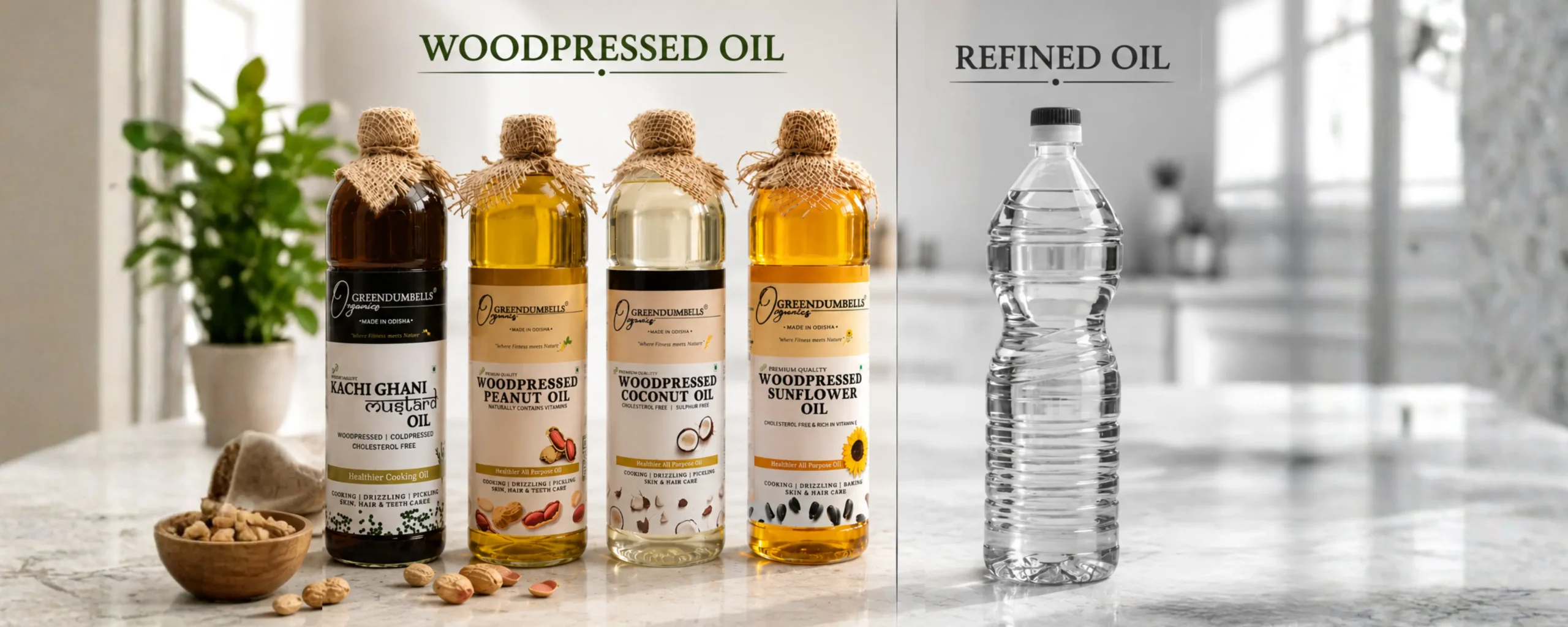
This guide breaks down exactly what happens to your oil before it reaches your kitchen — and why wood pressed oil is not a trend but a return to what actually nourishes your family.
What is Wood Pressed Oil?
Wood pressed oil, also called kachi ghani oil or cold pressed oil, is extracted by mechanically crushing oilseeds — mustard, coconut, groundnut, sunflower — using a wooden or stone press at temperatures below 40 degrees Celsius. No external heat is applied. No chemical solvents are used.
The oil that emerges is exactly what the seed contains: fatty acids, antioxidants, vitamins, and the natural aroma that tells your body this is real food.
The process is slow. A kachi ghani press may extract 30-35% of the oil from a batch of seeds, leaving a rich seed cake behind. That inefficiency is the point. The low-temperature, low-pressure extraction ensures that every heat-sensitive nutrient — Vitamin E, polyphenols, omega fatty acids — survives into the final oil.
How Wood Pressing Works: Step by Step
Seeds are cleaned and sun-dried to optimal moisture. The wooden press, driven by a motor or traditionally by a bullock, rotates a heavy wooden cylinder inside a conical chamber. Seeds fed into the chamber are crushed slowly and the oil drips out at the bottom, filtered through a fine cloth. No heat. No hexane. No deodorisation. The entire process takes 4-6 hours for what a chemical plant does in minutes — and that difference is everything.
What is Refined Oil? The Process They Do Not Show You
Refined oil starts with the same seeds but follows a very different journey. After initial mechanical pressing, the remaining seed cake — still containing 8-12% oil — is soaked in the solvent hexane to extract every last drop. The crude oil mixture then goes through a series of industrial processes: degumming (removing phospholipids), neutralisation (removing free fatty acids with sodium hydroxide), bleaching (removing colour with activated clay), and deodorisation (steam stripping at 200-260 degrees Celsius to remove smell).
By the time refined oil reaches your bottle, it is a chemically and thermally processed product. The natural colour is gone. The natural smell is gone. The antioxidants are degraded. Trace amounts of the solvent hexane may remain. What you are left with is predominantly fatty acids in an oil that is stable, long-lasting, and nutritionally hollowed out.
Refining Steps and What Each Destroys
Degumming removes lecithin and phospholipids — natural emulsifiers your body uses. Neutralisation with caustic soda removes free fatty acids but also strips carotenoids. Bleaching destroys chlorophyll and beta-carotene. Deodorisation at high temperatures degrades Vitamin E and can create trans fatty acid isomers. The final product passes food safety standards — it is not dangerous. But it is a shadow of what the seed offered.
Wood Pressed vs Refined Oil: The Complete Comparison
Smoke point is often cited as the reason refined oil wins in the kitchen. This is partly true — refined oils typically have higher smoke points because the volatile compounds that would smoke at lower temperatures have been removed. But smoke point is only one variable, and often the wrong one to optimise for most Indian cooking.
Most home cooking — tadka, curry, saute, stir fry — happens at 150-200 degrees Celsius. Cold pressed mustard oil has a smoke point of approximately 250 degrees Celsius. Cold pressed coconut oil sits at 177 degrees Celsius. For everyday Indian cooking, neither is a limitation. The smoke point argument for refined oil becomes relevant only in deep frying, where it genuinely has an advantage.
Nutrient Comparison
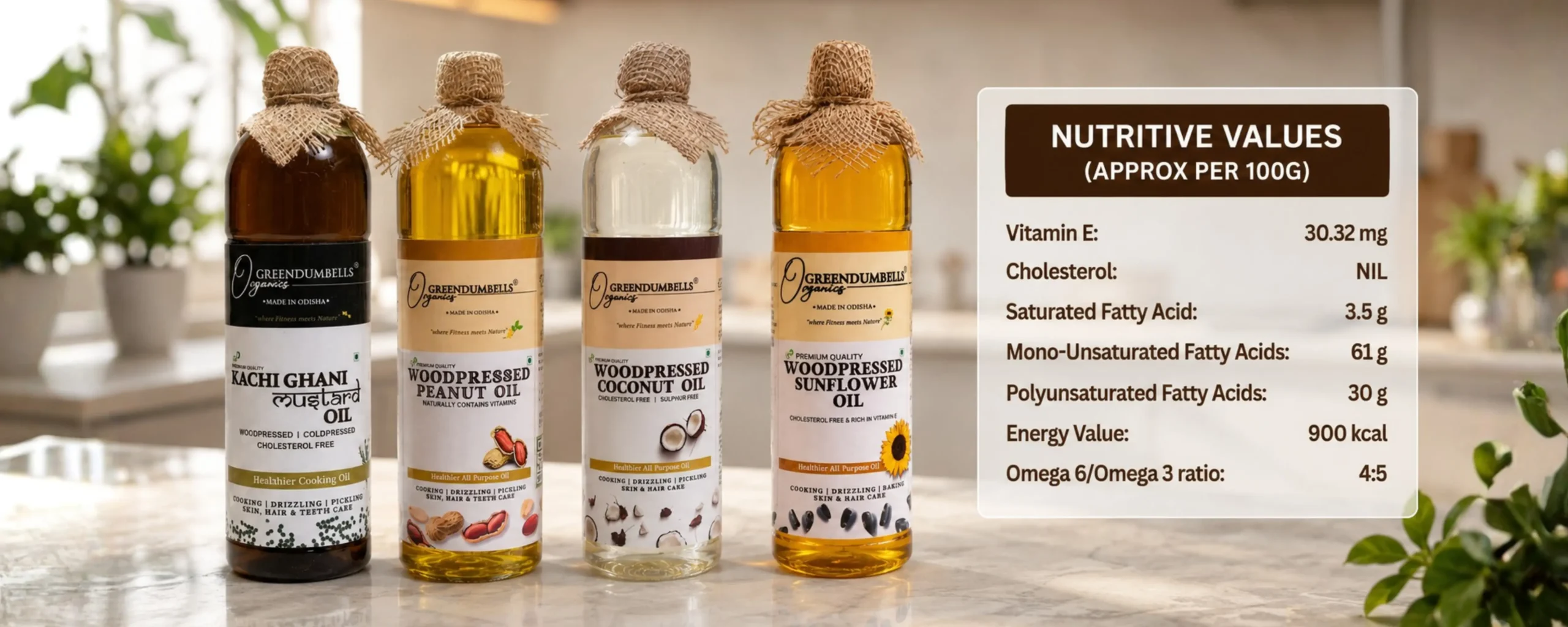
Vitamin E content: Cold pressed coconut oil retains 15-20mg per 100g; refined coconut oil retains 1-3mg. Polyphenols: cold pressed mustard oil contains 200-400mg per kg; refined mustard oil contains near zero. Natural antioxidants: fully present in cold pressed, largely destroyed in refined. Omega-3 to Omega-6 ratio: maintained in cold pressed, distorted in refined due to processing. Trans fats: absent in cold pressed, potentially present in trace amounts in refined due to deodorisation.
Which Oil Should You Use for Which Dish?
Wood pressed mustard oil is non-negotiable for Bengali fish curry, Odia pakhala bhat tadka, pickles (achaar), and any dish where you want that pungent, warming depth. The allyl isothiocyanate compounds in kachi ghani mustard oil that give it its sharp aroma are powerful antimicrobial agents.
Cold pressed coconut oil is ideal for South Indian cooking — coconut chutney tempering, Kerala-style fish curry, appam batter. It is also your best choice for medium-heat saute and any dish where coconut flavour belongs. Its lauric acid content has well-documented antimicrobial properties.
Cold pressed sunflower oil is the most neutral of the group, making it suitable for baking, salad dressings, and dishes where you want the ingredient flavours to lead, not the oil.
Why Most Indians Switched to Refined Oil — And Why That Was a Mistake
The shift happened in the 1980s and 1990s, driven by industrialisation of food production, aggressive marketing by FMCG companies positioning ‘refined’ as modern and hygienic, and price — refined oils were cheaper because chemical extraction is more efficient. By the 2000s, kachi ghani presses in most Indian towns had shut down or reduced to supplying local markets.
How to Identify Genuine Wood Pressed Oil
Real cold pressed oil has colour. Kachi ghani mustard oil is deep amber-yellow, almost brown. Cold pressed coconut oil is faintly golden or white when solid. Cold pressed groundnut oil is rich dark gold. If your ‘cold pressed’ oil is completely transparent and colourless, it has likely been filtered to a degree that removes natural compounds, or it is misrepresented.
Real cold pressed oil has sediment. A fine natural sediment at the bottom of the bottle is a good sign — it is natural plant matter that passed through filtration. Real cold pressed oil has a smoke that smells of the seed, not of burning fat. And real cold pressed oil is never dirt cheap — the lower yield of cold pressing means it costs more than refined oil.
Frequently Asked Questions
Ques: Is wood pressed oil suitable for deep frying?
Ans: For occasional deep frying, cold pressed mustard oil handles it fine. For large-volume commercial frying, refined oil has a practical advantage.
Ques: Does wood pressed oil go rancid faster?
Ans: Cold pressed oil does have a shorter shelf life than refined oil because natural compounds are retained. Stored in a cool, dark place and used within 3-4 months of opening, it does not present a practical issue for home use.
Ques: Can I mix cold pressed and refined oil?
Ans: You can, but there is no benefit. The whole point of cold pressed oil is its nutritional integrity. Mixing dilutes the benefit without meaningful cost savings.